
Overview
Overview & Docs
Made Scientific's Princeton campus at 307 College Road East, with the supporting documentation for this proposal.


Princeton Forrestal Center. Zoned PMOD, which permits laboratories and product development, and the building is already served by HVAC configured for once-through lab air — both material to a cleanroom fit-out. Parking at 4 spaces per 1,000 ft², on-site property management, and minutes from the New Jersey Transit station. Building data as published by the leasing agent; to be confirmed in diligence.
Summary
Responses to your questions
| Lead time to seven commercially-licensed GMP suites | Technology transfer starts 2027 at 201 College Road East or East Norriton, bridging to Princeton 307 for GMP, PPQ and commercial readiness. Made Scientific’s initial build-out at 307 — cleanrooms, laboratories, warehousing and cold storage — completes Q4 2027 – Q1 2028. The Artiva suite build runs 15–18 months from signature of the commercial agreement. |
| Cost through Technology Transfer and PLI / first commercial batch, 2027–2030 | $10.10M – $17.20M, with program initiation and GMP readiness fee-waived. |
| Cost per batch at 200 L, 20 batches per suite per year | $380K – $430K all-in — $864 to $977 per vial, inside your <$1,000 target. |
| Suite reservation fee | $0, against an agreed minimum annual batch commitment. |
| Staffing | Dedicated, not shared. Included in the batch fee. |
| Raw materials | $200K per batch, your assumption, passed through at cost. |
| Other — semi-annual APVs, stability, storage | Included in the batch fee. |
| Made Scientific versus other CDMOs | We fund and equip the suites — roughly $85M of build that a standard CDMO charges to you. |
Additional finding: the same seven rooms can support approximately 24% more output than the current plan assumes. The supporting analysis follows.
Lead time
Starting now, bridging to 307
The program does not wait on the 307 build. Technology transfer and engineering activities begin in existing licensed space — 201 College Road East in Princeton, or East Norriton in Pennsylvania — and bridge into 307 College Road East as each suite comes ready, carrying the process into GMP readiness, PPQ and commercial supply. Consolidating eFeeder production into 307 on the same path is a proposed move — options remain open, and would give a single-site regulatory footprint. Transfer site and suite configuration are both under joint review; see the supporting documents above.

Throughput
Increasing throughput within the same seven rooms
The eFeeder suite achieves approximately 60 batches per year from a 24-day campaign, as only the nine-day bioreactor step occupies the room. Applying the same principle to drug product — converting one DP suite into a seed room serving the other four — raises output from 107 to 133 batches per year within the same seven rooms. An eighth room raises this to 166.

Sensitivity model
Adjust the assumptions
Every figure in this proposal rests on assumptions that are stated explicitly. The model opens at Artiva's current configuration — five suites with the seed train in-suite. Setting “batches per suite” to 33 reflects a decoupled seed train.
Cost
Program cost
Through tech transfer, PPQ and PLI · 2027–2030
$10.10M – $17.20M
Program initiation and GMP readiness are fee-waived. At a standard CDMO both would be billed.
| Technology transfer — ICB, drug product, fill/finish | 2027 |
| Analytical method transfer, qualification and validation | 2027–28 |
| Engineering runs and GMP readiness | 2028 |
| Aseptic process simulation and PPQ campaign | 2029 |
| BLA support, PLI readiness, first commercial batch | 2030 |
Per batch at 200 L · tiered on volume
| Annual volume | Conversion | Materials | All-in | Per vial |
|---|---|---|---|---|
| up to 60 batches | $230K | $200K | $430K | $977 |
| 61 – 120 batches | $210K | $200K | $410K | $932 |
| 121 – 180 batches | $195K | $200K | $395K | $898 |
| over 180 batches | $180K | $200K | $380K | $864 |
Every tier sits within the <$1,000 per vial commercial COGS target Artiva has stated publicly. At eight vials per patient this equates to $6,909 – $7,818 per patient, against the $8,000 in Artiva's own materials.
Suite reservation fee: $0
Charged instead as an agreed minimum annual batch commitment, aligning payment with output rather than with reserved capacity.
Work package breakdown
The same total, by milestone and work order
The identical $10.10M – $17.20M from the previous section, decomposed to work-order granularity through Pre-License Inspection to commercial manufacturing. The splits below allocate the combined lines above across their constituent work orders — they do not add cost.
M1–M8 total: $10.10M – $17.20M. M9 — commercial manufacturing — carries no fixed fee; it is priced per batch under the volume-tiered schedule above, and forecast by configuration below.
Assumption stated explicitly: the technology-transfer-versus-engineering-run split within M2/M4, and the ICB/DP/fill-finish split within M6 PPQ, are Made Scientific's own allocation of an already-stated combined range — not independently estimated line items. Each work order can be requoted independently once the process points in the Technical Points of Clarification document are confirmed.
Commercial forecast
Volume-based discount, by configuration
Structured as a volume-discount schedule: as committed volume increases, the batch fee steps down. The schedule is anchored to Made Scientific's throughput options rather than to an Artiva demand forecast, as drug product volumes have not been shared. It therefore models cost against a rising share of each configuration's capacity.
| Illustrative year | Configuration | Ceiling | Commitment | Committed batches | Batch fee | Minimum annual fee | $/vial |
|---|---|---|---|---|---|---|---|
| 2030 (PLI & launch) | Option 1 | 107 | 50% | 54 | $230K | $12.42M | $977 |
| 2031 | Option 2 | 133 | 65% | 86 | $210K | $18.06M | $932 |
| 2032 | Option 3 | 166 | 80% | 133 | $195K | $25.93M | $898 |
| 2033+ | Option 4 | 265 | 90% | 238 | $180K | $42.84M | $864 |
The fee steps down as committed volume scales — $230K → $210K → $195K → $180K per batch — and every step remains inside your own <$1,000/vial commercial COGS target. Materials pass-through is additional at $200K/batch and is not part of the minimum fee.
Assumptions stated explicitly, not implied
- The year mapping (2030→2033+) is Made Scientific's proposed adoption sequence, not a commitment you have made or a demand forecast you have provided.
- Commitment levels (50% / 65% / 80% / 90%) are illustrative, structured to rise as the relationship matures — not yet negotiated with you.
- Batch fees are read from the tier schedule at each year's committed volume, not at the configuration's ceiling — pricing reflects what you actually commit to, not the capacity available. Matches the methodology of the ramp slider below.
- Real adoption timing depends on your actual demand, which has not been shared with Made Scientific as of this estimate.
Five-year volume ramp
Each year's volume can be set independently; no ramp shape is assumed. Fee per batch follows the tier schedule applied throughout this proposal.
Commercial model
Commercial model comparison
| A standard CDMO | Made Scientific | |
|---|---|---|
| Facility build-out | Charged to you — est. $30M–$40M | Absorbed |
| Suite fit-out and process equipment | Charged to you — est. $45M–$55M | Absorbed |
| FTEs / labor | Hire and manage your own — est. $7M–$11M/yr for a dedicated ~45–55 FTE team | Included in the batch fee — no separate hire |
| Suite reservation fee | Charged, non-refundable | $0 against a volume commitment |
| Program initiation | Charged | Waived |
| GMP readiness (APQ, CQV, equipment maintenance & calibration, EMPQ, etc.) | Charged | Waived |
| Dedicated program management | Charged — est. $15K/month | Included |
| Capacity | Shared, multi-client | Dedicated suites |
A seven-suite build is roughly $85M — our own estimate of $30M–$40M facility shell plus $45M–$55M suite fit-out and process equipment. Made Scientific funds both. FTEs are dedicated and not billed separately; their cost sits within the per-batch fee shown under Program cost, not in this comparison. Artiva commits to volume rather than to capital.
Appendix
Assumed Process Flow

eFeeder is consumed at every expansion step — the ICB bag phase, the seed train, and the 200 L top-ups. It is not one of the seven rooms as originally specified. Consolidating production into Princeton 307 alongside the rest of the process is a proposed move — options TBD, with the specific suite arrangement under joint review (see Documents).
Facility
Facility Layout Concept
Princeton — 307 College Road East. EwingCole / EC Build's cleanroom concept for the seven-suite expansion, with Grade B cores inside Grade C shells and unidirectional Annex 1 flow already designed in. Open the source PDF →
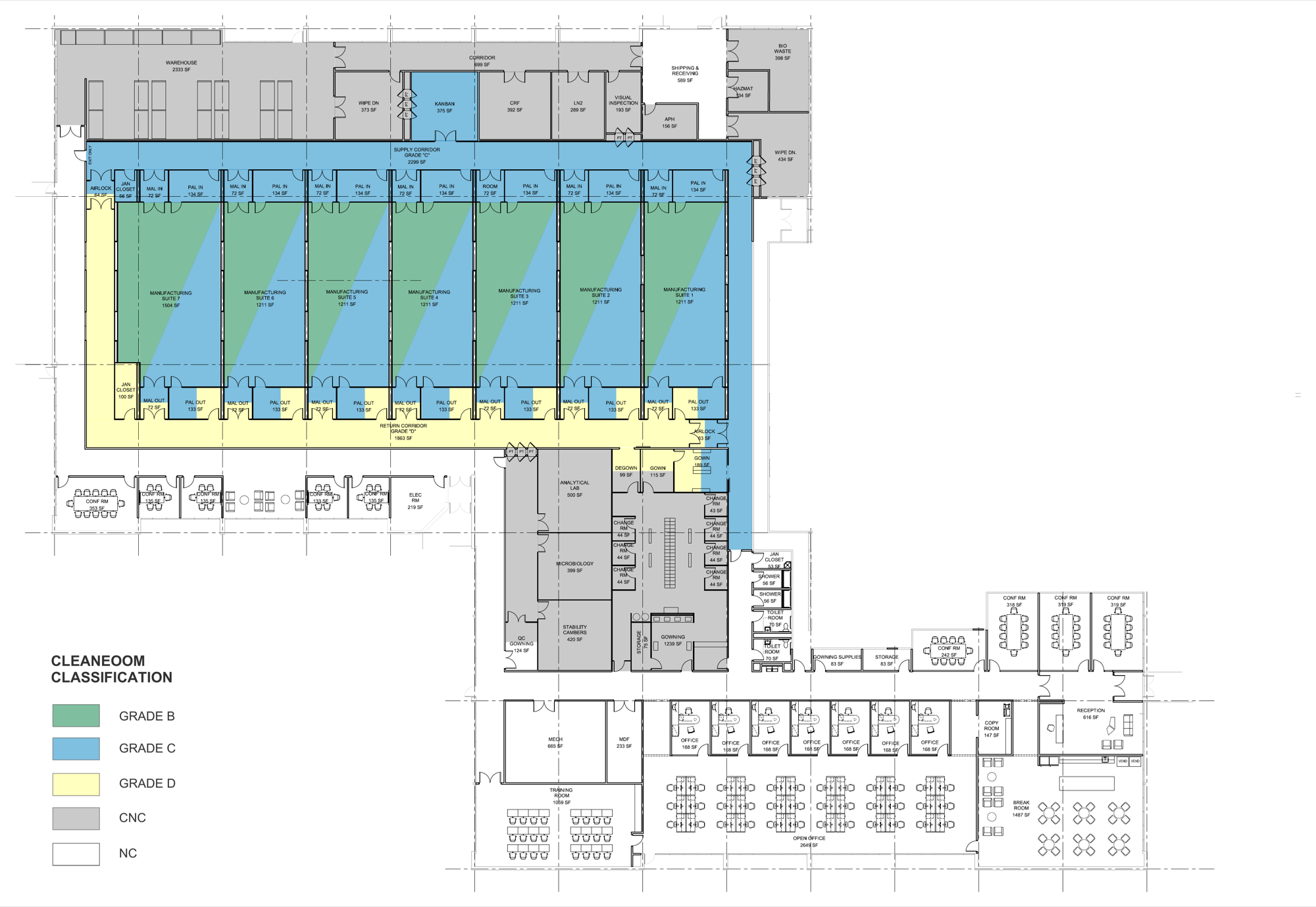
Seven uniform manufacturing suites along a Grade C supply corridor (top) feeding each suite's MAL/PAL IN, and a Grade D return corridor (bottom) taking MAL/PAL OUT — each suite drawn with a Grade B core inside the Grade C shell, accommodating either grade as the production standard. CNC support (warehouse, shipping & receiving, visual inspection) sits north of the supply corridor; QC and administrative space to the south.
Appendix
Suite floor plan and equipment

Schematic, not to scale, based on the 307 layout — the decoupled configuration, with suite 2 converted from drug product to a shared seed room. Equipment fit-out remains an open item; this reflects Made Scientific's modeling assumptions pending confirmation.
Appendix
Key equipment
Process equipment referenced throughout this proposal, funded and absorbed by Made Scientific.


The team
Program team
Made Scientific leadership, business development, Scientific Advisory Board and Board of Directors. The engagement is structured as an operating relationship rather than a supplier arrangement.
Leadership


Business Development


Scientific Advisory Board


Board of Directors


Next steps
- Confirm the process assumptions. A short technical session on seed-train duration, suite turnaround, NK seed density, feeder/vial thaw and expansion, and DP storage duration would replace our estimates with your numbers and tighten the ±30%.
- Resolve the suite configuration. eFeeder consolidating into Princeton 307 raises open design questions — one room or two for feeder + ICB, shared vs. per-suite harvest, and enlarged multi-suite rooms vs. individual suites for throughput. See the Technical Points of Clarification document.
- Capacity reservation. Secures a technology transfer slot and suite capacity, credited in full against work orders.
- Detailed proposal at work-order level, with a full Gantt to first commercial batch.